Recently I watched a video of two influencers in Dubai. While there was unrest and missiles were being launched from Iran toward the region, one asked the other: “Is there a war now?” The woman’s answer was as striking as it was illustrative:
“According to ChatGPT, officially not.”
That sentence stuck with me. According to ChatGPT, officially not.
As if a language model determines what reality is. As if something only becomes true when a chatbot confirms it. And perhaps even more importantly: as if an answer that sounds confident is automatically correct.
That is exactly one of the biggest misunderstandings around AI today.

The temptation of a convincing answer
In my conversations with clients, I increasingly hear the same idea: “Why would we still need a specialized data provider for this? I can just ask AI for that information, right?”
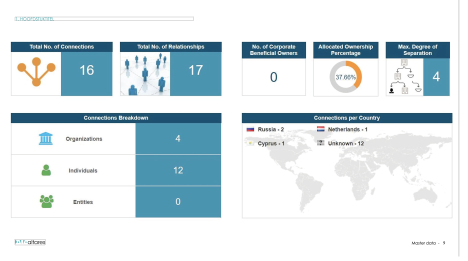
It often concerns business information that seems simple at first glance. How is a parent-subsidiary structure set up? Which legal entity belongs to which group? Who is ultimately responsible? Who is the UBO?
These are questions you can easily ask ChatGPT or another model. You usually get a neatly formulated answer in return quite quickly.
But fast and neat is not the same as correct.
AI is not a truth system
A generative AI model is not a truth system. It is a language model that recognizes patterns in text and generates the most likely answer based on those patterns.
That often works impressively well. Sometimes so well that it seems as if the system actually knows what is true.
But it doesn’t. There is no source registry. No verified database. No legal validation. Only a model trained on large amounts of text that produces a plausible output.
Interesting read: From AI FOMO to smart sales: why good data and MDM are crucial
The risk in a business context
In business, plausibility is not enough.
Especially not for topics such as:
- ownership and corporate structures
- UBO registrations
- compliance checks
- customer onboarding
- risk assessment
In these areas, you don’t want an answer that just sounds right. You want an answer that is correct and traceable.
You want to know where the information comes from, how up-to-date it is, and which entity is actually meant.
AI as interface, data as foundation
That is why it is important to clearly distinguish between AI as an interface and data as a foundation. AI is strong in making information accessible. It can summarize, structure, identify patterns, and make complex information understandable. That is where its value lies.
But the moment AI is treated as a source of truth, trust shifts from data to the model’s persuasiveness. And that is exactly where things can go wrong.
Why authentic data becomes more important, not less
The real value of AI lies not only in the model itself, but especially in the quality of the data it is allowed to build on. A generic model without controlled, up-to-date, and verifiable data can still sound convincing, but lacks reliability.
That is a fundamentally different approach from relying on a broadly trained model without source validation.
The real question for organizations
That is why the discussion is not only about which AI tool you use.
The real question is: what do you let AI rely on?
On open web information, training data, and probability?
or on authentic, up-to-date, verified business data specifically intended for making business decisions??
That difference is significant.
A generic model can help with searching, summarizing, and exploring. But when you need to be certain who the ultimate beneficial owner is, how a corporate structure is legally built, or which entity you are actually doing business with, you don’t want probability. You want verification.
The future is AI based on trusted data
AI is playing an increasingly important role in how we work and make decisions. But precisely because of that, the quality of the underlying data is becoming more important than ever.
The future is not AI versus data. The future is AI based on reliable data.
Interesting read: Agentic AI: from hype to practical reality
Conclusion: does it sound right, or is it actually right?
So yes, feel free to ask ChatGPT your questions. Use AI where it adds value. But never confuse a fluently formulated answer with reality itself.
The organizations that will use AI most effectively are not the ones that let the model talk the loudest. They are the ones that ensure the model has access to the right source.
Do I want an answer that sounds right? Or do I want an answer that is right?