UBO information changes and structures are rarely static. This section focuses on practical aspects: from complex ownership structures to monitoring UBO changes.
How do you determine UBOs?
1. Requesting UBOs from the organization itself
An organization may be asked in writing to provide an overview of shareholders with a 25% or greater interest. This is relatively simple, but it does involve risks:- you rely entirely on the information provided
- There is no automatic monitoring.
- the responsibility always remains with you
2. Conduct your own research
You can identify UBOs by using verified (international) sources. This provides greater control, but is often:
- time-consuming
- complex in international structures
- difficult due to language and registration differences
3. Support from an external party
A specialized partner can take care of the research for you. This saves time, but:
- final responsibility remains with your organization
The reliability of the partner is crucial.
The UBO-database
In addition to the national UBO register, there is also the UBO database. The main difference between the UBO register and the UBO database, is that the UBO database is an international collection of UBOs, pseudo-UBOs and shareholders. It also lists UBOs as young as 0.01% interest, instead of 25% with the UBO register.
Does every country have a UBO registry?
No, a UBO register is not mandatory worldwide. There is no international UBO register. Within the EU, however, this obligation does exist and all European countries have a UBO register. You can often request this from your local chamber of commerce. There are a number of snags, however. Determining a UBO can be quite difficult internationally once you start doing business outside the EU. Unfortunately, there is no international list of UBOs. Your best chance of success is to find an international partner to assist you with this.
How many UBOs does a company have?
This varies by company. Any natural person who owns 25% or more in stock is a UBO. But contrary to what you might think, more than four individuals may well be a UBO within a company. UBO structures can get very complicated.
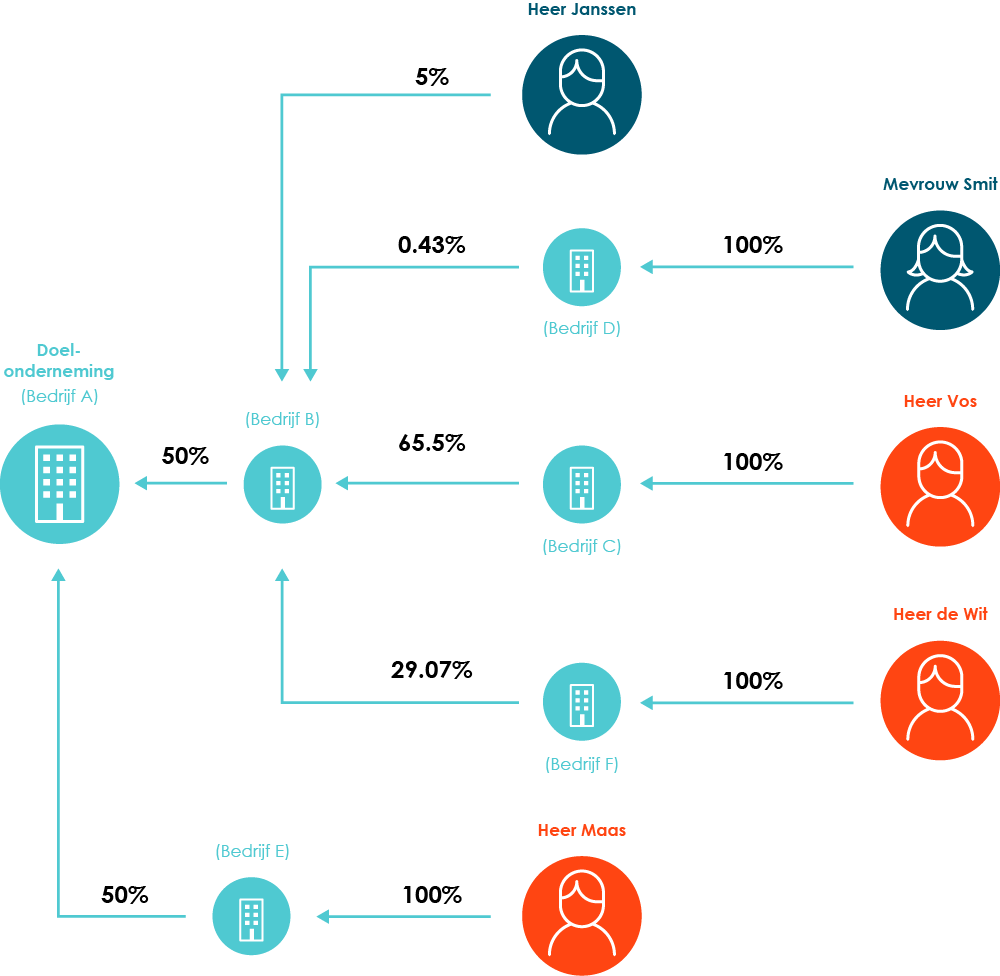
So you can see in this example that it is not immediately clear who the UBOs are. Both directly and indirectly, there are people with significant interests in the organizations. UBOs can also hide behind layers of limited liability companies. These complex structures make it difficult to identify UBOs.